
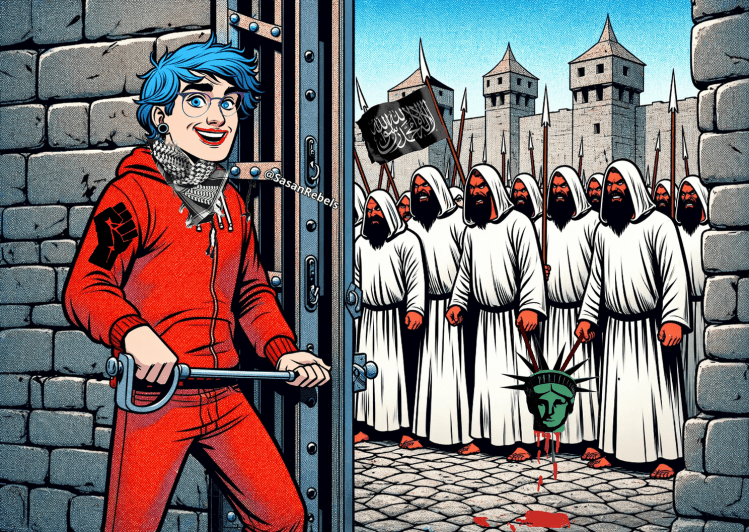

“Once you decide that American-led ‘globalization’ is the main enemy, then any revolt against it is better than none at all. In some way yet to be determined, Al-Qaeda might be able to help stave off global warming.”
Christopher Hitchens, ‘At Last Our Lefties See the Light’ (2006)
A striking and troubling feature of the modern Western Left is its persistent refusal to treat Islamic terrorism as an ideological phenomenon in its own right. Instead of engaging with jihadist movements as what they plainly are – actors driven by explicit theological commitments, political objectives, and internally consistent worldviews – they are repeatedly filtered through a set of familiar exculpatory narratives: as mere “blowback” from Western intervention, as residual fallout from colonial history, or as culturally misread expressions of some supposedly authentic tradition. In every case, agency is displaced outward, perpetrators are recast as effects rather than actors, and organised violence is dissolved into a haze of external causation.
These explanations are not simply partial; they are intellectually evasive. They operate as a protective interpretive screen that shields jihadist ideology from the level of scrutiny routinely applied to other political and religious systems. The effect is a discourse in which Islamic terrorism is endlessly historicised and contextualised, yet rarely confronted on its own stated terms, and in which its explicit doctrinal and political claims are treated as peripheral, if they are acknowledged at all. This essay rejects those apologetic frameworks and argues that Islamic extremism should be understood not as a by-product of grievance or circumstance, but as a coherent ideological project with substantive internal roots and motivations.
*****
1: Reactionism
A recurring claim in contemporary leftist discourse holds that jihadist movements are fundamentally reactive – the inevitable consequence of Western imperialism, the product of poverty and state collapse, or the expression of anti-colonial resistance. Whether framed as a reaction to foreign intervention, the outcome of material deprivation, or a form of militant Third-Worldism, the conclusion is the same: jihadist violence is not driven by ideology, but by circumstance.
This narrative is profoundly mistaken. It systematically erases what jihadist movements themselves insist upon: that their violence is theological, intentional, and rooted in a coherent worldview that cannot be reduced to grievance or deprivation. Groups such as Al-Qaeda, ISIS, Boko Haram, the Taliban, and Hamas do not merely react to political conditions – they pursue a vision. That vision is explicitly theocratic, supremacist, and global in scope. It is anchored in a theology that divides the world into Dar al-Islam (the Domain of Islam) and Dar al-Harb (the Domain of War), mandating endless struggle until Islamic rule prevails everywhere.
At the core of this worldview is not simply opposition to Western policy, but a doctrinal hostility toward unbelief itself. In Islamic theology, pluralism is not tolerated, but condemned as shirk (polytheism) and kufr (disbelief); apostasy is not merely a difference of views, but high treason. The faithful are commanded to despise unbelievers not for worldly harms like occupation or injustice, but because their rejection of Islam constitutes an intolerable insult to Allah. In fact, to hate non-Muslims for their violence against Muslims rather than their unbelief is itself blasphemy – for it elevates human dignity above divine honour. In a sermon titled ‘They Abuse Allah’, Sheikh Ahmad Musa Jibril explains this clearly:
This is why Islamic terrorists feel justified in slaughtering civilians who have never harmed Muslims: for in their unbelief, non-Muslims are guilty of abusing Allah. The Qur’an, the hadith literature, and classical jurisprudence explicitly reinforce this genocidal logic, commanding Muslims to fight non-Muslims not as a contingent response to oppression, but as a religious obligation. Verse 9:29, for instance, instructs Muslims to “fight those who do not believe in Allah” until they are subdued and pay tribute. The promise of paradise for those who kill and are killed “in the way of Allah” is reiterated in verses like 9:111. These texts are not fringe interpretations – rather, they form the doctrinal basis for jihadist movements worldwide.
Indeed, the theological imperative to kill non-Muslims long predates Western colonialism. Islamic conquests, beginning in the 7th century, spread through vast swathes of the Middle East, North Africa, and South Asia not through diplomacy, but through wars justified by divine sanction. The brutal subjugation of non-Muslims under dhimma contracts, the mass enslavement of infidels, and the persecution of heretics and apostates are not colonial inventions – they are defining features of classical Islamic empires inspired by sacred texts and enforced by religious courts.
Attempts to explain jihadism through poverty or state collapse fare no better. Nowhere is this clearer than in the case of the Taliban. Afghanistan has undeniably suffered from decades of war and economic devastation. But these conditions did not generate the Taliban’s fanaticism; to a significant extent, they are its consequence. The movement has repeatedly prioritised doctrinal purity over material welfare – banning girls’ education, restricting women’s participation in public life, destroying cultural heritage, and enforcing brutal punishments even when such policies exacerbate famine, isolation, and institutional collapse.
When faced with a choice between alleviating suffering and maintaining ideological control, the Taliban have consistently chosen the latter. Their 2022 ban on Afghan women working for NGOs, imposed despite warnings that it would cripple humanitarian relief efforts during a famine crisis, showed a willingness to sacrifice effective aid delivery in order to preserve their social and religious authority. Such actions make clear that the Taliban’s primary objective is not prosperity or stability, but the enforcement of divine law. If Islamic extremism were fundamentally a product of deprivation, one would expect it to soften as conditions worsen; the opposite has occurred. Ideology does not bend to material reality – it overrides it.
The historical record leaves no ambiguity. Long before 9/11 or the subsequent U.S. invasion of Afghanistan, the Taliban of the 1990s had already banned women from work, outlawed girls’ schooling, and enforced gender apartheid through floggings and executions. The immediate restoration of these policies after the American withdrawal in 2021 demonstrates that their repression is neither reactive nor pragmatic. It is doctrinal and deliberate.
A second contemporary illustration of this dynamic can be seen in the Islamic Republic of Iran. Whatever role Western intervention has played in the country’s history, the present regime cannot be reduced to external causation. It is a self-sustaining theocratic state whose authority rests explicitly on Shi’a jurisprudence and the doctrine of clerical guardianship (Wilayat al-Faqih) established by the Ayatollah Khomeini in the Islamic Revolution of 1979. Its murderous repression of gays and apostates, its systematic persecution of women (particularly those who refuse the hijab), and its suppression of political opposition are not contingent reactions to foreign pressure, but expressions of its governing ideology.
This remains true even under conditions of severe external and internal pressure. In recent years, Iran has faced crippling sanctions, sustained protest cycles, violent state crackdowns, and escalating military confrontation – including direct conflict with both Israel and the United States. Yet rather than moderating in response to instability and economic strain, the regime has consistently intensified coercive control, expanding executions, tightening surveillance, and reinforcing compulsory religious norms as instruments of political authority. In other words, material crisis has not diluted ideological rigidity, but rather accelerated it.
Reducing such movements to economic desperation not only misdiagnoses the problem – it inverts it morally. Religious zealots are recast as victims, while their actual victims – women, dissidents, and religious minorities – are rendered invisible. Afghan women demanding education or Iranian women demanding equality become “Western proxies”, while those who imprison, flog, or kill them are recast as authentic agents of resistance. In this framework, the oppressed are denied even the right to resist their own rulers. An anti-imperialism that permits this inversion forfeits any claim to emancipatory purpose. This distortion arguably reaches its most extreme form in the portrayal of Hamas as a legitimate resistance movement.
Contrary to the romanticism of naive Western leftists, Hamas is not a secular resistance movement seeking statehood or self-determination. It is a jihadist organisation rooted in theocratic fascism, whose explicitly stated goals are to annihilate the Jews and restore the Caliphate. This is made clear in the Hamas Charter, a document rarely quoted in apologetic discourse because of its raw, unfiltered hatred. Originally adopted in 1988, the Charter cites a hadith declaring that “The Day of Judgement will not come until Muslims fight the Jews and kill them,” thus embedding apocalyptic antisemitism into the movement’s founding ideological framework.
The Charter further rejects any political compromise or two-state solution, declaring that “there is no solution to the Palestinian problem except through Jihad” and insisting that every inch of land once ruled by Muslims – especially Palestine – must be returned to Islamic control. Thus, the Israeli-Palestinian conflict is framed not as a dispute over land or sovereignty, but as a divinely ordained war of conquest. Jews are depicted not merely as political opponents, but as enemies of Allah whose presence must ultimately be eradicated. Even if Israel withdrew from every disputed territory and never fired another shot, Hamas would still seek to destroy the Jews and subjugate the land to Islamic rule, as its own clerics openly admit:
Attempts to sanitize Hamas’ image with PR-friendly documents, such as its 2017 statement, do not nullify the Charter nor its actual practice. The group’s actions and leadership rhetoric remain unchanged. Before his well-earned elimination by the Israeli military, Yahya Sinwar repeatedly referred to martyrdom and jihad as the central pillars of their strategy. In public rallies, Hamas officials chant about the conquest of Jerusalem, the annihilation of Jews, and the eventual expansion of Islamic rule. These are not metaphors. On October 7th 2023, Hamas militants crossed into Israel and brutally massacred over 1,200 civilians – babies beheaded, women raped, families burned alive. This was not “resistance”, but a pogrom comparable to Muhammad’s slaughter of the Jews of the Banu Qurayza in 627 AD.
And while Western leftists posture as defenders of the Palestinian cause, we must ask: what has Hamas done for ordinary Palestinians? It has used civilians as human shields in flagrant violation of the laws of war, embedding its military infrastructure within densely populated areas. It has squandered vast sums of foreign aid on weapons – stored in hospitals – and on terror tunnels built beneath homes and schools. Public dissent is met with imprisonment or execution without trial. Children are indoctrinated with the language of martyrdom rather than educated for peace. Women’s rights, LGBT rights, and press freedom are entirely absent. Small wonder, then, that many Palestinians are risking their lives to protest their brutal regime:
Now of course, none of this is to deny that Western interventions have had consequences. Military campaigns, regime-change efforts, and alliances with authoritarian regimes have often intensified instability and resentment. But these are accelerants, not root causes. They do not manufacture the imperative for global conquest, nor the eschatological promise of martyrdom, nor the violent hatred of non-Muslims and perceived heretics that characterises jihadist movements. To imagine that Islamic terrorism would disappear if only the wicked West “minded its own business” is a dangerous delusion.
This becomes clearer when one considers the 2016 Brussels bombings and the 2019 Easter bombings in Sri Lanka – jihadist attacks in countries with no direct military involvement in the Middle East. Consider also the sectarian violence within Muslim-majority societies such as Iraq, Pakistan, and Afghanistan, where Shi’a communities and other minorities have repeatedly been targeted in bombings and mass killings justified through religious delegitimisation, and ISIS’ campaign of extermination and enslavement against the Yazidis in Iraq and Syria. Across these cases, violence is not reducible to Western foreign policy or local grievance, but reflects a recurring logic in which non-Muslims, sectarian minorities, and other out-groups are framed as religiously illegitimate and therefore permissible targets.
To deny the theological drivers of Islamic terrorism is to ignore the self-professed motives of its perpetrators and to mislead those seeking to confront the threat. It is not a principled show of solidarity with the oppressed, but an abject display of cowardice before the oppressor. “Anti-fascists” who refuse to confront the Islamic far-Right have abandoned the very principles that they claim to defend.
*****
2: Historical Revisionism
Another claim frequently advanced by leftist apologists for jihad is that while the Taliban are undeniably religious despots, they were ultimately created by the West – and that prior to foreign meddling, Muslim societies were more pluralistic, tolerant, and socially dynamic, with rich cultural and civic institutions. This argument collapses under scrutiny, on both counts.
Although the United States and its allies supported the Afghan mujahideen during the Soviet invasion of the 1980s, the Taliban did not emerge until the mid-1990s – years after the Soviet withdrawal and the end of the Cold War. The movement arose primarily from the madrassahs of Pakistan, where a generation of Afghan refugees was indoctrinated with Deobandi (Sunni revivalist) Islam. It was financed by Gulf petro-monarchies, shaped by local jihadist currents, and inspired by theological ideas that have been around for well over 1,400 years. To portray the Taliban as merely a Western creation is therefore to ignore the movement’s own ideological foundations and regional sponsors. Western policies may have influenced the environment in which the Taliban emerged, but the Taliban’s worldview, goals, and methods are rooted in Islamic tradition.
Pakistan illustrates a similar pattern. Its descent into theocratic governance is often attributed to Cold War geopolitics – particularly U.S. support for General Zia ul-Haq – but the foundations of religious authoritarianism were laid decades earlier. The 1949 Objectives Resolution, passed just two years after independence, declared that sovereignty belongs to Allah alone and that all laws must conform to Islamic injunctions. This was not foreign policy imposition; it was a homegrown decision to enshrine divine law above democratic governance. In 1974, Pakistan’s parliament amended the constitution to declare Ahmadis to be non-Muslims, institutionalising sectarian discrimination. These domestic policies created fertile ideological soil in which Zia’s later Islamization – censorship, Hudood Ordinances, and educational reforms – could flourish. They were not breaks with Pakistan’s past, but intensifications of long-standing internal trends.
The rise of Wahhabism (Salafism) in 18th-century Arabia further weakens the claim that jihadist movements are Western creations. Muhammad ibn Abd al-Wahhab, a cleric from central Arabia, launched a campaign to “purify” Islam by eradicating practices he deemed idolatrous, calling for a return to the literalist and especially intolerant version of the faith championed by Ibn Taymiyyah, “the great Islamic revivalist”. In 1744, he forged an alliance with Muhammad ibn Saud, combining uncompromising theology with tribal militarism to create the first Saudi state. Wahhabi campaigns involved mass killings of Shi’as, Sufis, and other Muslims, the destruction of towns and holy sites, and the enforcement of rigid social conformity. These atrocities arose from a homegrown movement of religious absolutism, not from Western interference. Western powers would later ally with Saudi Arabia, but they neither invented Wahhabism nor dictated its methods.
Claims that Muslim countries like Egypt or Iraq were liberal or pluralistic before Western intervention are equally misleading.
In the Arab provinces of the Ottoman Empire, political authority rested on dynastic and bureaucratic rule rather than representative institutions or democratic accountability. The Ottoman millet system, an institutionalised form of the older Islamic dhimma framework, granted limited autonomy to recognised non-Muslim communities, but legal inequality, slavery, blasphemy laws, gender segregation, and restrictions on freedom of conscience remained deeply entrenched. Colonial administrators often governed through existing religious and political institutions rather than creating them from scratch. British authorities in Egypt retained Islamic courts, while French authorities in the Levant worked alongside sectarian elites and communal power structures. Western intervention often intensified sectarian rivalries and reshaped local power dynamics, but it did not create the region’s longstanding traditions of authoritarian government or religiously grounded politics.
*****
3: Cultural Relativism
A further defence of jihadist movements by Western leftists is that the Taliban embody authentic Islamic traditions and Afghan cultural values – and thus, that condemning them amounts to cultural imperialism or “Islamophobia”. Again, this is profoundly wrong on both counts.
Firstly, the banning of girls’ education and the public flogging of women are not “expressions of Afghan culture”; they are tools of theocratic control imposed by a militant ideology. The Taliban are not timeless avatars of Afghan tradition – they are religious extremists shaped by Deobandi radicalism and Wahhabi authoritarianism. To conflate this with Afghan culture is to erase the vast diversity of Afghan life: its poets, musicians, secularists, feminists, and reformers – all of whom the Taliban seek to silence or destroy.
And even if Taliban practices were traditional, that would not excuse them. Culture is not a moral blank cheque. No sane or decent person would defend foot-binding or female genital mutilation just because they are “cultural”. Human rights do not stop at the borders of Afghanistan. Binding women in burqas, beating them for showing skin, or denying them education are acts of domination, not tradition – and they deserve moral condemnation, not apologetics.
Indeed, cultural relativism in this context is deeply patronising. It treats Afghans as if they are less deserving of rights and less capable of moral reasoning than the rest of us. When Western commentators suggest that Afghan women “don’t mind” wearing the burqa, or that “modesty” is simply part of their culture, they are not defending diversity – they are denying these women the ability to speak for themselves. They are ignoring the thousands of Afghan women who have risked their lives to oppose these practices, from schoolgirls poisoned or shot on their way to class, to activists jailed and tortured for demanding the basic rights that Western “liberals” are so eager to relativise away. Just listen to the words of Sumaya – locked up at home for nearly five years, banned from going to school or university by the Taliban. She urges Afghan girls to try and learn any way that they can, and begs the world for help:
Secondly, criticising jihadist regimes is not bigotry, but solidarity with the victims of religious tyranny. There is a world of difference between hatred for Muslims as a people and opposition to Islamic theocracy. Is it “Islamophobic” to denounce the Taliban’s ban on girls’ education? To criticise Hamas for executing peaceful protestors in Gaza? To condemn the Islamic Republic for beating Iranian women to death over a strand of exposed hair? Of course not. To conflate such criticism with racism is to perform the most insidious kind of moral inversion – one that casts the oppressor as the victim and brands their critics as hate-mongers.
Ironically, the people most damaged by this rhetorical sleight of hand are Muslims themselves. It is Muslims who are murdered by jihadist regimes for being insufficiently devout. It is Muslims who are imprisoned, tortured, or exiled for advocating secularism or democracy. It is Muslim women who face forced veiling, child marriage, and house arrest under Islamist rule. And it is Muslims, especially those in the West, who are increasingly bullied into silence by the threat of being called traitors or “native informants” if they voice dissent. When Western activists declare that criticising political Islam is Islamophobic, they are not defending Muslim communities – they are abandoning them to their most reactionary and violent elements.
No ideology – religious, political, or otherwise – should be immune from criticism. To declare a set of ideas to be beyond reproach because they are Islamic is to treat Muslims as a monolithic bloc incapable of disagreement, reform, or moral agency. This is not anti-racism; it is soft bigotry masquerading as solidarity. The same prejudice underlies the reluctance to condemn Islamist movements such as the Taliban, as though they should be judged by different moral standards. It implies that Afghans should be expected to endure forms of oppression that would be intolerable anywhere else. To relativise the Taliban’s human rights abuses is not to respect Afghan culture, but to excuse the suffering they inflict on millions.
*****
4: Whataboutism
Another desperate defence of Islamofascism by the modern Left is the claim that religious patriarchy is not unique to Islam or the Taliban. The argument is that because Christianity, Judaism, Hinduism, and other traditions have long histories of restricting women’s roles, condemning the Taliban’s treatment of women more forcefully amounts to selective outrage.
This is a false and deeply repugnant equivalence. There is a categorical difference between institutional sexism in pluralistic societies and the system of gender apartheid imposed by jihadist regimes. The Taliban are not merely patriarchal – they are violently anti-women. Girls are banned from secondary school and university. Women are confined to their homes under threat of arrest, forced to cover up from head to toe, denied the right to work, to travel without a male guardian, or to receive medical care from male doctors. They have eliminated women from public life – not as an unfortunate consequence of dogma, but as an explicit goal.
The relevant moral standard here is not whether a religion contains sexist doctrines, but whether those doctrines are imposed through state violence, backed by law, and enforced with imprisonment, beatings, or death. By that standard, the comparison collapses. To equate the Taliban’s rule with, for example, the Catholic Church’s refusal to ordain female priests is to confuse exclusion with incarceration, and discrimination with total domination.
Western religious communities, for all their flaws, operate within legal frameworks that protect individual rights. Women may dissent, leave their faith, criticise religious authorities, and participate fully in civic life without fear of state punishment. No Christian denomination in the West imprisons women for removing a veil. No Jewish community expels girls from school at gunpoint. No Buddhist institution codifies beatings for unaccompanied women into law. The difference is not theological nuance; it is coercive power.
The claim that “all religions are the same” does not advance equal scrutiny – it dissolves scrutiny altogether. It relies on flattening moral distinctions so severe that abuses can be relativised away. Worse still, it obscures the reality that women in Muslim-majority societies are actively resisting these regimes, often at extraordinary personal risk. Afghan women demanding education, Iranian women defying morality police, and Muslim feminists challenging clerical rule are not asking for cultural indulgence; they are asking for solidarity. Too often, that solidarity is withheld by commentators who are more concerned with avoiding accusations of cultural insensitivity than opposing oppression.
Notably, this relativism is selectively applied. If a Christian fundamentalist government were to ban women from universities, arrest them for travelling alone, and enforce gender segregation with whips and rifles, global condemnation would be immediate and unambiguous. The hesitation that emerges when similar abuses are carried out by Islamist regimes reflects not cultural understanding, but a chilling combination of fear, political caution, and lowered moral expectations. That is not principled anti-racism; it is the quiet acceptance of injustice under another name.
The struggle for women’s rights is not a comparative exercise in theological inconsistency. It is a concrete fight for education, freedom of movement, and basic dignity. To excuse the Taliban by noting that other religions have patriarchal histories is to abandon Afghan girls who are barred from classrooms today. It protects theocrats while betraying their victims – and reveals that, for Western “liberals”, opposition to patriarchy evaporates when it becomes politically inconvenient.
*****
Conclusion
What unites these apologetic frameworks is not intellectual depth, but a consistent refusal to look directly at the ideological content of Islamist movements themselves. Whether framed as a reaction to Western interference, as the product of colonial history, as culturally relative, or as no worse than other religious traditions, the effect is the same: the agency of jihadist actors disappears, and moral accountability is displaced onto everything except the perpetrators.
This is not serious analysis – it is political theatre. It allows the Left to maintain the comforting fiction that violence they find ideologically inconvenient must always be the West’s fault, while treating Islamist movements with a level of interpretive leniency rarely extended to any other force. In doing so, they do not advance understanding of oppression; they obscure it. They do not stand in solidarity with victims; they erase them behind layers of explanatory abstraction.
A politics that cannot name ideological violence for what it is, without immediately dissolving it into Western culpability or cultural relativism, forfeits its claim to moral seriousness. As Ex-Muslims – and more importantly, as human beings – we stand with the victims of jihadist terror and dictatorship throughout the world.


Excellent summary and analysis of the problem, i.e. the cowardly and tragic capitulation of the Occidental “left” to Islamic fascism.
Many thanks for writing and posting this.
— David Rand
LikeLiked by 1 person