

Say: “Bring your proof, if ye are truthful.”
Qur’an 27:64
Among those who have renounced Islam, it is widely held that the best way to help Muslims is to liberate them from the shackles of their religion. A crucial part of this endeavour is to shatter the myth of the miraculous nature of the Qur’an, i.e. that the text is a work of such supreme excellence that it could only have come from Allah, the Almighty. Such is the purpose of this article: to demonstrate that the Qur’an, being riddled with contradictions, is but the product of Muhammad’s own mind, exposing the limitations thereof.
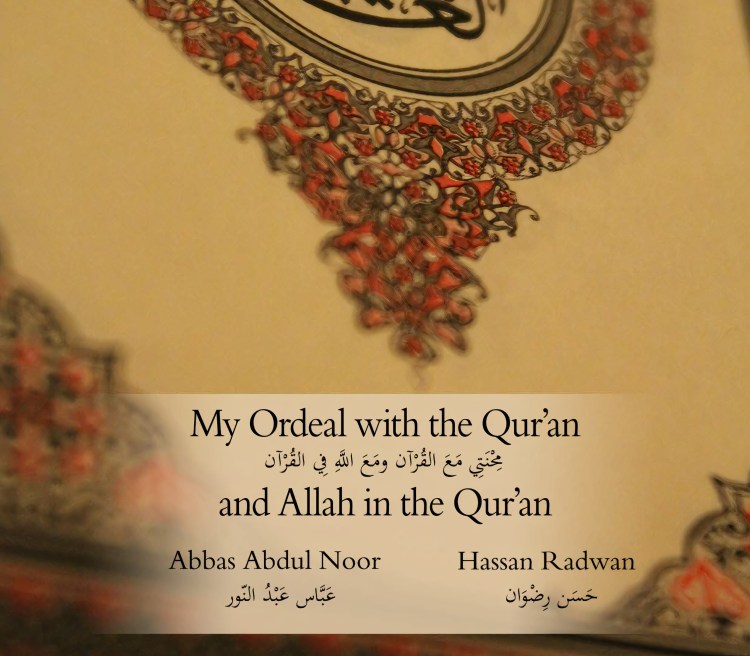
In the main, we will derive our examples from My Ordeal with the Qur’an and Allah in the Qur’an by Abbas Abdul Noor, translated by Hassan Radwan. Noor, an Egyptian author and once a prominent scholar of Sufism, came to renounce Islam in his seventies after a lifelong battle with doubts. “To my horror,” Noor writes, “God’s answer was the opposite of what I begged him for.” His book is both a devastating critique of the Qur’an and an impassioned plea for Muslims to throw off the chains of orthodoxy. In his words:
The Qur’an remains a stumbling block to our full participation in the progress and changes mankind has made in recent history. Whereas the West has witnessed a revolution in the way holy texts are perceived, releasing them from their shackles and separating church from state, we have been completely unable to change the way we view our holy text, and have been left stranded. The contrast between a secular society that is dynamic, free, and open to change, and a society that is backward, stagnant, and one that, apart from just doing the same things and repeating itself, is idle, is a truly disgraceful and shameful state of affairs. While the classical stage of our history was dynamic and potent, able to give and take, create and innovate, investigate and examine, our present stage is characterised by apathy, stagnation, and blind, regressive fundamentalism that is not proficient in anything apart from the language of intolerance, violence, blood and death. This language is taking us deeper into the darkness.
But of course, the contradictions which abound in the Qur’an are just one reason to doubt its divine authorship. The discontinuity and variant readings, the grammatical and scientific errors – all of these combine to reveal the book’s artificial origin. In a future piece, we may explore these issues with reference to the works of Ibn Rawandi, Al-Razi, and other titans of apostasy. For now, we will content ourselves with 20 examples of Qur’anic contradictions. With any luck, this effort will prove to be an effective antidote to Muslim bibliolatry.
*****
1: The source of evil
In verse 4:78, it is stated that all things, both good and evil, are from Allah:
If some good befalls them, they say, “This is from Allah”; but if evil, they say, “This is from thee” (O Prophet). Say: “All things are from Allah.” But what hath come to these people, that they fail to understand a single fact?
But in the verse which immediately follows, the Qur’an states that only good comes from Allah, while evil comes from man:
Whatever good, (O man!) happens to thee, is from Allah; but whatever evil happens to thee, is from thy (own) soul. And We have sent thee as a messenger to (instruct) mankind. And enough is Allah for a witness.
Scholarly Explanation and Response:
Islamic scholars attempt to reconcile these verses by distinguishing between Allah’s ultimate sovereignty and human moral responsibility. They argue that verse 4:78 affirms that all events, including suffering and misfortune, occur within Allah’s decree, while verse 4:79 addresses human accountability by attributing evil actions to human choices. According to this interpretation, Allah creates and permits all things, but individuals remain responsible because they freely choose their actions.
However, this distinction does not remove the underlying tension. Verse 4:78 explicitly states that “all things” come from Allah, including the evil events that occur in the world, while verse 4:79 appears to shift responsibility for evil onto humanity. The reconciliation therefore depends on separating ultimate causation from moral responsibility – a distinction not explained within the verses themselves. If Allah’s will ultimately determines all events, the question remains how human responsibility can coexist with complete divine sovereignty.
*****
2: The will of Allah
In verse 6:148, the Qur’an rebukes the Meccan polytheists for arguing that if Allah had wanted them to abandon idolatry, he would have made it so. It challenges them to bring forth evidence for this claim, and accuses them of lying:
Those who give partners (to Allah) will say: “If Allah had wished, we should not have given partners to Him nor would our fathers; nor should we have had any taboos.” So did their ancestors argue falsely, until they tasted of Our wrath. Say: “Have ye any (certain) knowledge? If so, produce it before us. Ye follow nothing but conjecture; ye do nothing but lie.”
And yet, in the very next verse, the Qur’an makes this same argument. It states explicitly that if it had been the will of Allah, the polytheists would have been guided:
Say: “With Allah is the argument that reaches home. If it had been His will, He could indeed have guided you all.”
Scholarly Explanation and Response:
Islamic scholars attempt to reconcile these verses by arguing that they address different aspects of divine will and human responsibility. They claim that verse 6:148 condemns the polytheists for using Allah’s decree as an excuse to justify their idolatry, while verse 6:149 affirms that Allah’s will ultimately governs all things. According to this interpretation, Allah permits people to go astray but does not compel them to reject the truth.
However, this explanation leaves the central difficulty unresolved. The polytheists’ argument in verse 6:148 is rejected precisely because they attribute their idolatry to Allah’s will, yet verse 6:149 appears to confirm that Allah could have guided them but chose not to. The distinction between “allowing” misguidance and “causing” it does not fully resolve the issue, since the outcome still depends on Allah’s decision. The verses therefore create a tension between divine sovereignty and human accountability that remains difficult to reconcile.
*****
3: The Jews
In the Qur’an, the Jews are described in multiple instances as God’s chosen people:
O Children of Israel! Call to mind the (special) favour which I bestowed upon you, and that I preferred you to all others (for My Message). [2:47]
O Children of Israel! Remember My favour wherewith I favoured you and how I preferred you to (all) creatures. [2:122]
However, in other verses, the Jews are rebuked for making this very same claim:
Say (O Muhammad): “O ye who are Jews! If ye claim that ye are favoured of Allah apart from (all) mankind, then long for death if ye are truthful.” [62:6]
The Jews and Christians say: “We are sons of Allah and His loved ones.” Say: “Why then doth He chastise you for your sins? Nay, ye are but mortals of His creating. He forgiveth whom He will, and chastiseth whom He will. Allah’s is the Sovereignty of the heavens and the earth and all that is between them, and unto Him is the journeying.” [5:18]
Scholarly Explanation and Response:
Islamic scholars attempt to reconcile these passages by arguing that the Qur’an’s description of the Children of Israel as “chosen” refers to their historical role as recipients of revelation and prophets, rather than granting them permanent superiority or immunity from judgement. They argue that this favour was conditional upon obedience to Allah, and that later verses criticise Jews who relied on ancestry rather than righteousness.
However, this interpretation requires a qualification that is not explicitly stated in the earlier verses. The passages describing the Children of Israel as favoured by Allah present this status as a divine distinction without clearly limiting it to a specific period or making it conditional. Meanwhile, verses such as 62:6 and 5:18 condemn Jews for claiming a privileged relationship with Allah – a claim that appears to reflect the very status granted to them elsewhere in the Qur’an. The result is an unresolved ambiguity over whether being “chosen” represents a permanent divine favour, a temporary historical role, or a conditional covenant.
*****
4: The Day of Judgement
In verses 11:106-107, the Qur’an states that on the Day of Judgement, the wretched will be sent to hell and abide therein for as long as the heavens and Earth endure:
As for those who will be wretched (on that day) they will be in the Fire; sighing and wailing will be their portion therein, abiding there so long as the heavens and the earth endure save for that which thy Lord willeth. Lo! Thy Lord is Doer of what He will.
However, according to verse 21:104, the heavens and Earth are set to be rolled up on the Day of Judgement:
The Day when We shall roll up the heavens as a recorder rolleth up a written scroll. As We began the first creation, We shall repeat it. (It is) a promise (binding) upon Us. Lo! We are to perform it.
How can the duration of punishment be measured by the continued existence of the heavens and the earth if, according to 21:104, the heavens themselves are rolled up on the Day of Judgement?
Scholarly Explanation and Response:
Islamic scholars attempt to reconcile these verses by arguing that the phrase “as long as the heavens and the earth endure” is not intended as a literal measurement of time, but as an expression meaning an extremely long or indefinite duration. They further argue that the phrase “except as your Lord wills” demonstrates Allah’s absolute control over the duration of punishment, while the destruction of the present heavens and earth marks the transition into a new eternal order.
However, this explanation depends on interpreting the language figuratively rather than according to its apparent meaning. Verses 11:106-107 appear to use the endurance of the heavens and the earth as a measure of punishment, while verse 21:104 describes those same heavens and earth being rolled up on the Day of Judgement. The proposed reconciliation therefore requires additional assumptions about metaphorical language and a future cosmic order that are not made explicit in the passages themselves.
*****
5: Whom Allah guides
In verse 16:104, the Qur’an states that Allah will not guide those who do not believe in his signs:
Those who believe not in the Signs of Allah – Allah will not guide them, and theirs will be a grievous Penalty.
This contradicts the many other verses where Allah guides the unbelievers to Islam:
They impress on thee as a favour that they have embraced Islam. Say, “Count not your Islam as a favour upon me: Nay, Allah has conferred a favour upon you that He has guided you to the faith, if ye be true and sincere.” [49:17]
And hold firmly to the rope of Allah all together and do not become divided. And remember the favor of Allah upon you – when you were enemies and He brought your hearts together and you became, by His favour, brothers. And you were on the edge of a pit of the Fire, and He saved you from it. Thus does Allah make clear to you His verses that you may be guided. [3:103]
It is no crime in you if ye seek of the bounty of your Lord (during pilgrimage). Then when ye pour down from (Mount) Arafat, celebrate the praises of Allah at the Sacred Monument, and celebrate His praises as He has directed you, even though, before this, ye went astray. [2:198]
Indeed, it is a simple fact that the majority of those who embraced Islam in Muhammad’s time would have formerly been polytheists. But according to verse 16:104, Allah does not guide the unbelievers. Who guided these people, then – Satan?
Scholarly Explanation and Response:
Islamic scholars attempt to reconcile these verses by arguing that verse 16:104 refers not to all unbelievers, but specifically to those who knowingly reject Allah’s signs and persist in disbelief. They maintain that those who later accepted Islam were not excluded from divine guidance because they remained open to the truth when it was presented to them. According to this interpretation, Allah withholds guidance only from those who deliberately turn away from it.
However, the verse itself does not make this distinction. It states simply that Allah will not guide those who disbelieve in His signs, while other verses describe former unbelievers as having been guided by Allah into faith. The qualification that only stubborn or wilfully rebellious disbelievers are denied guidance is therefore an interpretive addition rather than a distinction made explicitly in the text. This raises a broader tension within the Qur’anic concept of guidance: whether belief ultimately depends on human openness or on Allah’s decision to guide whomever He wills.
*****
6: The inhabitants of hell
In verse 17:97, the dwellers of hell are described as blind, dumb, and deaf:
It is he whom Allah guides, that is on true Guidance; but he whom He leaves astray – for such wilt thou find no protector besides Him. On the Day of Judgement, We shall gather them together, prone on their faces, blind, dumb, and deaf: their abode will be Hell: every time it shows abatement, We shall increase from them the fierceness of the Fire.
This contradicts other verses, wherein the inhabitants of hell talk to each other, disown one another, and beg those in heaven for help:
(On the day) when those who were followed disown those who followed (them), and they behold the doom, and all their aims collapse with them. And those who were but followers will say: “If a return were possible for us, we would disown them even as they have disowned us.” Thus will Allah show them their own deeds as anguish for them, and they will not emerge from the Fire. [2:166-167]
The Companions of the Fire will call to the Companions of the Garden: “Pour down to us water or anything that Allah doth provide for your sustenance.” They will say: “Both these things hath Allah forbidden to those who rejected Him.” [7:50]
Scholarly Explanation and Response:
Islamic scholars attempt to reconcile these descriptions by arguing that the Qur’an’s depiction of the inhabitants of Hell as “blind, dumb, and deaf” is metaphorical rather than literal. They claim that these terms refer to the spiritual condition of the damned – their inability to perceive truth, respond to guidance, or escape judgement – rather than a physical inability to see, hear, or speak. The passages describing them conversing and pleading are therefore understood as describing other aspects of their punishment.
However, this explanation relies on treating the language of verse 17:97 differently from the other descriptions of the inhabitants of Hell. The verse itself does not indicate that “blind, dumb, and deaf” is being used metaphorically, and other passages portray the damned literally speaking, arguing, and appealing for assistance. The reconciliation therefore depends on an interpretive distinction not explicitly provided by the text: that the same individuals are physically capable of communication while simultaneously described using terms that normally imply the loss of those faculties.
*****
7: Previous warners
In verse 35:24, it is stated that every nation prior to Muhammad was sent a warner from Allah:
Lo! We have sent thee with the Truth, a bearer of glad tidings and a warner; and there is not a nation but a warner hath passed among them.
This contradicts verse 25:51, which implies that Allah refrained from doing so:
And had We willed, We would have raised a warner in every town.
To be clear, the words ‘nation’ (أمة) and ‘town’ (مدینة) have the same meaning in the Qur’an. They mean a sedentary group that resides in a particular place where it seeks its living and sustenance. In fact, they are also applied to transient groups that are non-sedentary, such as in verse 28:23:
And when he arrived at the watering (place) in Madyan, he found there a group [أمة] of men watering (their flocks), and besides them he found two women who were keeping back (their flocks).
Scholarly Explanation and Response:
Islamic scholars attempt to reconcile these verses by arguing that they refer to different aspects of Allah’s sending of messengers. They interpret verse 35:24 as establishing the general principle that every nation received a warner at some point in history, while verse 25:51 is understood as stating that Allah could have sent a separate warner to every individual town had He wished. According to this interpretation, the latter verse does not deny the existence of previous warners but emphasises Allah’s discretion in how revelation was delivered.
However, this reconciliation depends on imposing a distinction between “nation” and “town” that is not made explicit in the passages themselves. Verse 35:24 appears to make a universal claim that no community was left without a warner, while verse 25:51 appears to acknowledge that Allah chose not to raise a warner in every settlement. The attempt to harmonise the verses therefore depends on an interpretation of one passage that is not explicit in the text itself, rather than resolving the apparent tension between them.
*****
8: Jonah (Yunus)
In verses 37:139-146, the Qur’an describes how Allah cast the prophet Jonah (Yunus) onto the shore:
So also was Jonah among those sent (by Us).
When he ran away (like a slave from captivity) to the ship (fully) laden,
He (agreed to) cast lots, and he was condemned:
Then the big Fish did swallow him, and he had done acts worthy of blame.
Had it not been that he (repented and) glorified Allah,
He would certainly have remained inside the Fish till the Day of Resurrection.
But We cast him forth on the naked shore in a state of sickness,
And We caused to grow, over him, a spreading plant of the gourd kind.
However, verses 68:48–49 state that, had Allah’s grace not reached Jonah, he would have been cast onto the shore “in disgrace”:
So wait with patience for the Command of thy Lord, and be not like the Companion of the Fish – when he cried out in agony. Had not Grace from his Lord reached him, he would indeed have been cast off on the naked shore, in disgrace.
Scholarly Explanation and Response:
Islamic scholars attempt to reconcile these verses by arguing that they describe different aspects of Jonah’s ordeal. They maintain that verses 37:139-146 describe Allah’s mercy after Jonah’s repentance, when he was cast onto the shore sick but forgiven, whereas verses 68:48-49 refer to the disgrace that would have followed had Allah’s grace not intervened. According to this interpretation, Jonah suffered physical hardship but was spared moral humiliation through divine mercy.
However, this distinction between physical suffering and disgrace is not clearly expressed in the text. In verses 37:145-146, Jonah is portrayed as having fled, being swallowed by a great fish, and being cast onto the shore weak and dependent upon Allah’s provision – circumstances that naturally appear humiliating. The later statement that he would have been cast ashore “in disgrace” therefore raises the question of how that outcome differs from the one already described. The reconciliation depends on introducing a distinction that the verses themselves do not explain.
*****
9: The justice of Allah
In verses 37:22-23, the Qur’an states that on the Day of Judgement, the wrongdoers will be held accountable for their actions:
Allah will say to the angels, “Gather all the wrongdoers along with their peers, and whatever they used to worship instead of Allah, then lead them all to the path of Hell.”
However, in verse 16:93, we are told that Allah is responsible for sending people astray:
Had Allah willed, He could have made you (all) one nation, but He sendeth whom He will astray and guideth whom He will, and ye will indeed be asked of what ye used to do.
Needless to say, it is a mockery of justice for Allah to punish those whom he causes to go astray. To quote verse 18:49:
And your Lord does injustice to no one.
Scholarly Explanation and Response:
Islamic scholars attempt to reconcile these verses by arguing that Allah’s act of leading some people astray does not remove their responsibility for their actions. They maintain that misguidance occurs as a consequence of human rejection of truth, and that Allah’s decision to allow individuals to remain astray is consistent with His justice because people freely choose their own path. In this view, divine decree and human accountability operate together, even if the relationship between them is beyond human understanding.
However, this explanation leaves unresolved the central tension in the passages. Verse 16:93 explicitly attributes guidance and misguidance to Allah’s will, while verses describing divine judgement present the misguided as deserving punishment for their condition. If Allah determines who is guided and who is led astray, then the basis for holding those who are not guided fully responsible becomes difficult to establish. The appeal to free will therefore requires a theological framework that is not directly articulated in these verses themselves.
*****
10: A clear Qur’an
In verse 15:1, the Qur’an is described as being clear or unambiguous:
These are the verses of the Book and a clear Qur’an.
However, in verse 3:7, we are told that only Allah knows the meaning of some verses:
But those in whose hearts is perversity follow the part thereof that is allegorical, seeking discord, and searching for its hidden meanings, but no one knows its hidden meanings except Allah.
Scholarly Explanation and Response:
Islamic scholars attempt to reconcile these verses by arguing that the Qur’an’s description of itself as “clear” refers to its overall message and purpose, rather than implying that every verse is equally straightforward. Verse 3:7 explicitly acknowledges that the Qur’an contains allegorical or ambiguous passages whose full meaning may be known only to Allah. According to this interpretation, the Qur’an can therefore provide clear guidance while containing particular verses whose deeper meanings remain beyond human comprehension.
However, this explanation shifts the meaning of “clear” from the text itself to its general message. If some verses are deliberately ambiguous and their meaning is known only to Allah, then the Qur’an is not universally clear in the ordinary sense of the term. This is especially significant if those verses form part of a divine message intended to guide humanity. The claim that the Qur’an is clear can therefore be maintained only by distinguishing between the clarity of its overall guidance and the clarity of its individual statements – a distinction that is developed through interpretation rather than explicitly stated in the text.
*****
11: Jesus (Isa)
In verse 4:157, the Qur’an describes how Allah placed the likeness of Jesus on another man, thus deceiving people into believing that he had been crucified:
And (for) their saying, “Indeed, we have killed the Messiah, Jesus, the son of Mary, the messenger of Allah.” And they did not kill him, nor did they crucify him; but (another) was made to resemble him to them. And indeed, those who differ over it are in doubt about it. They have no knowledge of it except the following of assumption. And they did not kill him, for certain.
Yet, in verse 3:85, the Qur’an states that Christians will be losers in the afterlife for not following Islam – in other words, for believing in Allah’s Jesus deception:
And whoever seeks a religion other than Islam, it will never be accepted of him, and in the Hereafter he will be one of the losers.
Scholarly Explanation and Response:
Islamic scholars attempt to reconcile these verses by arguing that verse 4:157 does not describe Allah deliberately deceiving humanity, but rather correcting a false belief about Jesus’ crucifixion. They maintain that those who believed Jesus had been crucified were mistaken because Allah protected His prophet, and that verse 3:85 condemns those who reject Islam rather than those who merely hold an incorrect historical belief. According to this interpretation, the issue is not that Allah deceived people, but that humanity misunderstood what occurred.
However, this explanation does not fully address the difficulty raised by the passage. Verse 4:157 explicitly states that Jesus was made to resemble another person, resulting in people believing that the crucifixion had taken place. Whether understood as a deliberate act or a divinely permitted deception, the outcome is the same: a central Christian belief is attributed to a misunderstanding caused by Allah’s intervention. If those who accepted the crucifixion were misled by a circumstance Allah Himself created, the question remains why they are condemned for failing to accept a different account of events.
*****
12: The creation of man
In the Qur’an, Allah appears to be very confused about how he created humans. Verse 3:59 states that Adam, the first man, was created out of dust:
The similitude of Jesus before Allah is as that of Adam; He created him from dust, then said to him: “Be.” And he was.
However, verse 15:26 states that man was made from clay:
We created man from sounding clay, from mud moulded into shape.
Then we have verse 19:67, which states that he was created out of nothing:
But does not man call to mind that We created him before out of nothing?
Then there is verse 21:30, which states that every living thing was made from water:
Do not the Unbelievers see that the heavens and the earth were joined together (as one unit of creation), before we clove them asunder? We made from water every living thing. Will they not then believe?
Finally, verses 96:1-2 state that man was created from a blood clot:
Recite: In the Name of thy Lord who created, created Man of a blood-clot.
Scholarly Explanation and Response:
Islamic scholars attempt to reconcile these descriptions by arguing that the Qur’an presents different aspects of human creation rather than contradictory origins. They maintain that Adam’s creation from dust and clay refers to the material from which he was formed, that creation from nothing emphasises Allah’s ability to bring existence into being, and that references to water and a blood clot concern the biological creation of human beings. According to this interpretation, the verses describe different stages or perspectives of creation.
However, this explanation depends on assigning different meanings to each description without the text itself clearly identifying those distinctions. The Qur’an presents these statements independently, using different substances to describe human origin, without explicitly explaining that they refer to separate stages of creation. The reconciliation therefore relies on a harmonising framework introduced by later interpretation rather than a distinction clearly established within the verses themselves.
*****
13: The word of Allah
In multiple verses of the Qur’an, it is stated that the word of Allah cannot change, for he guards his revelations against corruption:
We have, without doubt, sent down the Message; and We will assuredly guard it (from corruption). [15:9]
The word of thy Lord doth find its fulfilment in truth and in justice: None can change His words: for He is the one who heareth and knoweth all. [6:115]
And recite (and teach) what has been revealed to thee of the Book of thy Lord: none can change His Words, and none wilt thou find as a refuge other than Him. [18:27]
However, verse 2:75 describes how a group of Jewish rabbis used to change the words of the Torah:
Do you (faithful believers) covet that they will believe in your religion in spite of the fact that a party of them (Jewish rabbis) used to hear the Word of Allah (Torah), then they used to change it knowingly after they understood it?
Additionally, in verse 3:78, Allah condemns those who distort his scripture:
And lo! There is a party of them who distort the Scripture with their tongues, that ye may think that what they say is from the Scripture, when it is not from the Scripture. And they say: “It is from Allah”, when it is not from Allah; and they speak a lie concerning Allah knowingly.
Furthermore, verse 16:101 states that Allah exchanges one verse for another at will:
And when We exchange a verse in the place of another verse – and God knows very well what He is sending down – they say, “Thou art a mere forger!” Nay, but most of them have no knowledge.
Scholarly Explanation and Response:
Islamic scholars attempt to reconcile these verses by distinguishing between Allah’s words themselves and human distortion of their meaning or transmission. Some interpret verses 2:75 and 3:78 as describing Jews who misrepresented, concealed, or distorted the meaning of revelations they had received, rather than altering Allah’s words themselves. Others have understood taḥrif (distortion) more literally, arguing that earlier scriptures were also subject to textual alteration, while the Qur’an was uniquely promised divine preservation. Verse 16:101 is then explained through the doctrine of abrogation (naskh), whereby Allah replaces one ruling with another according to His wisdom, without this constituting a change in His eternal knowledge.
The first interpretation avoids a direct contradiction by treating taḥrif as distortion of meaning rather than alteration of Allah’s words. But the second creates a more obvious difficulty: if the Torah and Gospel were genuine revelations from Allah, how could their words subsequently be altered if Allah’s words cannot be changed? Restricting the promise of preservation to the Qur’an provides a theological distinction, but that distinction is not stated in verses 6:115 or 18:27 themselves. Likewise, if abrogation involves replacing one revealed command with another, it creates a tension between an unchanging divine word and a changing revealed message. The apparent contradiction can therefore be avoided, but only by assigning different meanings and scopes to “Allah’s words” and “change” than the verses themselves explicitly establish.
*****
14: The first Muslim
In multiple instances, the Qur’an states that Muhammad is the first Muslim, i.e. one who surrenders to Allah:
Say: “Shall I choose for a protecting friend other than Allah, the Originator of the heavens and the earth, Who feedeth and is never fed?” Say: “I am ordered to be the first to surrender (unto Him).” And be not thou (O Muhammad) of the idolaters. (6:14)
Say: “Verily, my Salat (prayer), my sacrifice, my living, and my dying are for Allah, the Lord of the ‘Alamin (mankind, jinns and all that exists). He has no partner. And of this I have been commanded, and I am the first of the Muslims.” (6:162-163)
However, according to verses 2:130-132, Abraham (Ibrahim) and his sons preceded Muhammad in being Muslims, followed by Jacob (Yaqoub):
And who forsakes the religion of Ibrahim but he who makes himself a fool, and most certainly We chose him in this world, and in the hereafter he is most surely among the righteous. When his Lord said to him, “Be a Muslim”, he said: “I submit myself to the Lord of the worlds.” And the same did Ibrahim enjoin on his sons and (so did) Yaqoub. O my sons! Surely Allah has chosen for you (this) faith, therefore die not unless you are Muslims.
Scholarly Explanation and Response:
Islamic scholars attempt to reconcile these verses by arguing that Muhammad’s description as the “first Muslim” does not refer to the first person in history to submit to Allah, but rather to the first among his own people to accept and proclaim the final revelation of Islam. They maintain that Abraham and earlier prophets were also Muslims in the broader sense of submission to Allah, but Muhammad was the first within the context of his prophetic mission.
However, this interpretation requires adding a qualification that is absent from the verses themselves. The passages describing Muhammad as “the first of the Muslims” do not specify that this applies only to his community or to the final form of revelation. Meanwhile, verses concerning Abraham, his descendants, and Jacob explicitly describe them as Muslims before Muhammad’s time. The reconciliation therefore depends on redefining the meaning of “first” rather than resolving the apparent contradiction between the two claims.
*****
15: Intercession
In verse 39:44, the Qur’an states that all intercession belongs to Allah, i.e. that only Allah has the power to intercede on behalf of someone:
Say: “To Allah belongs all intercession. His is the Sovereignty of the heavens and the earth, then to Him you shall be brought back.”
However, verse 2:255 suggests that certain individuals can intercede with Allah’s permission:
Allah – there is no deity except Him, the Ever-Living, the Sustainer of [all] existence. Neither drowsiness overtakes Him nor sleep. To Him belongs whatever is in the heavens and whatever is on the earth. Who is it that can intercede with Him except by His permission?
Scholarly Explanation and Response:
Islamic scholars attempt to reconcile these verses by arguing that all intercession ultimately belongs to Allah because no one can intercede independently of His authority. They maintain that verse 2:255 does not grant others a power separate from Allah, but rather describes Allah permitting certain individuals to intercede on His behalf. According to this interpretation, Allah remains the sole owner of intercession while allowing it to occur through those whom He chooses.
However, this explanation creates a tension between exclusive ownership and delegated participation. Verse 39:44 states that all intercession belongs to Allah alone, while verse 2:255 introduces the possibility of others interceding with His permission. Although Allah remains the ultimate authority, the practical function of intercession is no longer exclusive if it can be exercised by others. The reconciliation therefore depends on distinguishing between possessing intercession and granting access to it – a distinction that is not explicitly developed in the verses themselves.
*****
16: Intoxicants and gambling
In verse 2:219, the Qur’an acknowledges both good and evil in wine and gambling, but discourages their use:
They ask thee concerning wine and gambling. Say: “In them is great sin, and some profit, for men; but the sin is greater than the profit.”
Further, verse 4:43 prohibits Muslims from approaching prayer while drunk, implying that alcohol use outside of prayer was acceptable:
O ye who believe! Draw not near unto prayer when ye are drunken, till ye know that which ye utter, nor when ye are polluted, save when journeying upon the road, till ye have bathed.
However, in verses 5:90-91, Allah summarily declares intoxicants and gambling to be abominations and strictly prohibits them:
O ye who believe! Intoxicants and gambling, (dedication of) stones, and (divination by) arrows are an abomination of Satan’s handwork: eschew such (abomination), that ye may prosper. Satan’s plan is (but) to excite enmity and hatred between you, with intoxicants and gambling, and hinder you from the remembrance of Allah, and from prayer: will ye not then abstain?
Scholarly Explanation and Response:
Islamic scholars attempt to reconcile these verses by arguing that the Qur’an’s position on intoxicants and gambling developed gradually. They maintain that verses 2:219 and 4:43 represent earlier stages of divine guidance, acknowledging the harms of these practices while allowing time for their eventual prohibition. Verses 5:90-91 are then understood as the final ruling, establishing a complete ban once the community was prepared to accept it. According to this interpretation, the apparent change reflects a deliberate process of gradual legislation rather than contradiction.
However, this explanation raises questions about the nature of divine guidance. The earlier verses do not merely condemn intoxicants and gambling while preparing for a future prohibition; they acknowledge some benefit and permit their use under certain circumstances. The later declaration that they are an “abomination” and the work of Satan therefore represents a significant shift in how these practices are presented. The reconciliation depends on accepting that Allah revealed different moral rulings at different stages, raising the broader question of how an eternal and perfect divine command can develop through successive revisions.
*****
17: Peace vs. violence
In verses 109:1-6, Allah instructs Muhammad to issue a message of peace and tolerance to those who disbelieve in Islam:
Say: “O disbelievers, I do not worship what you worship. Nor are you worshippers of what I worship. Nor will I be a worshipper of what you worship. Nor will you be worshippers of what I worship. For you is your religion, and for me is my religion.”
However, in verse 9:5, Allah commands Muslims to kill the polytheists until they repent and convert to Islam:
And when the sacred months have passed, then kill the polytheists wherever you find them and capture them and besiege them and sit in wait for them at every place of ambush. But if they should repent, establish prayer, and give zakah, let them (go) on their way. Indeed, Allah is Forgiving and Merciful.
Furthermore, verse 9:29 orders Muslims to fight the People of the Book (Jews and Christians) until they pay the jizyah and are brought low:
Fight those who believe not in Allah nor the Last Day, nor hold that forbidden which hath been forbidden by Allah and His Messenger, nor acknowledge the religion of Truth, (even if they are) of the People of the Book, until they pay the Jizya with willing submission, and feel themselves subdued.
Scholarly Explanation and Response:
Islamic scholars attempt to reconcile these passages by arguing that they address different historical circumstances. They maintain that verses 109:1-6 express a principle of religious distinction and non-coercion during a period when Muslims were not engaged in armed conflict, while verses 9:5 and 9:29 relate to specific conflicts involving hostile groups and political opposition to the early Muslim community. According to this interpretation, the Qur’an does not present contradictory commands but rather provides different rulings for different situations.
However, this explanation largely assumes the very distinction it seeks to establish. Nothing in 109:1-6 explicitly limits its principle of religious tolerance to a period of Muslim weakness, nor do 9:5 and 9:29 themselves clearly state that their commands are confined to a particular historical circumstance. If the more violent passages are permanently applicable, they qualify the apparent tolerance of 109:6; if they are not, their supposed limitation must be supplied through interpretation. The appeal to context therefore does not resolve the tension so much as relocate it.
*****
18: The order of creation
In verses 41:9-11, the Qur’an states that the Earth was created first, followed by the heavens:
Say, “Do you indeed disbelieve in He who created the earth in two days and attribute to Him equals? That is the Lord of the worlds.”
And He placed on the earth firmly set mountains over its surface, and He blessed it and determined therein its (creatures’) sustenance in four days without distinction – for (the information) of those who ask.
Then He directed Himself to the heaven while it was smoke and said to it and to the earth, “Come (into being), willingly or by compulsion.” They said, “We have come willingly.”
However, verses 79:27-30 state that the heavens were created first, followed by the Earth:
Are you a more difficult creation or is the heaven? Allah constructed it. He raised its ceiling and proportioned it. And He darkened its night and extracted its brightness. And after that He spread the earth.
Scholarly Explanation and Response:
Islamic scholars attempt to reconcile these passages by arguing that they describe different stages of creation rather than contradictory sequences. They maintain that verses 41:9-11 refer to the initial creation of the Earth and the subsequent preparation of its features, while verses 79:27-30 refer to the formation of the heavens followed by the later spreading and completion of the Earth. According to this interpretation, the Qur’an is not describing the same event sequence, but different stages within a broader process.
However, this explanation depends on introducing a distinction between the Earth’s creation and its later shaping that is not explicitly stated in the verses themselves. On a straightforward reading, verses 41:9-11 present the Earth before the heavens, while verses 79:27-30 present the heavens before the Earth was spread out. The reconciliation therefore relies on assigning different meanings to the creation language in each passage rather than resolving the apparent chronological discrepancy directly.
*****
19: Apostasy
In verse 2:256, the Qur’an declares that there is no compulsion in religion:
Let there be no compulsion in religion: Truth stands out clear from Error: whoever rejects evil and believes in Allah hath grasped the most trustworthy hand-hold, that never breaks. And Allah heareth and knoweth all things.
However, verse 4:89 commands Muslims to kill those who turn away from Islam:
But if they turn away, then seize them and kill them wherever you find them and take not from among them any ally or helper.
Scholarly Explanation and Response:
Islamic scholars attempt to reconcile these verses by arguing that they address different concepts: verse 2:256 concerns the voluntary acceptance of faith, while verse 4:89 concerns individuals who abandoned the Muslim community in a context of political hostility or military conflict. According to this interpretation, the command to seize and kill those who “turn away” does not refer to private changes of belief, but to acts of betrayal and defection that threatened the early Muslim community.
However, this distinction is not explicit in the verse itself. Verse 4:89 commands that those who “turn away” should be seized and killed, without clearly stating that the offence is political betrayal rather than apostasy itself. If the verse is limited to treason, that limitation must be supplied through interpretation rather than the wording of the text. Moreover, even if the verse concerns political defection, the broader tension remains: a religion that declares “there is no compulsion in religion” must still explain why abandoning that religion can become grounds for punishment.
*****
20: The number of angels at Badr
In verse 8:9, Allah reminds Muslims of how he sent a thousand angels to assist them in the Battle of Badr:
(Remember) when you asked help of your Lord, and He answered you, “Indeed, I will reinforce you with a thousand from the angels, following one another.”
However, verse 3:124 mentions three thousand angels being sent down:
(Remember) when you said to the believers, “Is it not sufficient for you that your Lord should reinforce you with three thousand angels sent down?”
Scholarly Explanation and Response:
Islamic scholars attempt to reconcile these verses by arguing that they describe different stages of divine assistance during the Battle of Badr. They maintain that verse 8:9 refers to an initial reinforcement of one thousand angels, while verse 3:124 describes a later increase to three thousand as the situation developed. According to this interpretation, the differing numbers reflect a progression in Allah’s support rather than an inconsistency.
However, the Qur’an itself provides no explicit indication that the two figures represent successive stages of reinforcement. The idea that the number of angels increased from one thousand to three thousand is therefore an interpretive reconstruction rather than a conclusion directly derived from the passages. While such a reconciliation is possible, it depends on assumptions not stated in the text itself, leaving the relationship between the two accounts unresolved.

