

“I distrust those people who know so well what God wants them to do, because I notice it always coincides with their own desires.”
Susan B. Anthony
Among Muslims, it is an article of faith that the Qur’an was revealed to Muhammad from Allah, the Almighty. Muhammad was but a messenger; he did not compose the Qur’an, but merely received it from Allah via the angel Gabriel, as with all the prophets and scriptures that preceded him. He dictated the verses of the Qur’an to his companions, but did not have any influence over their content or the circumstances of their revelation. The Qur’an is thus held to be the direct words of Allah, free from mortal influence.
This narrative falls apart upon a rudimentary examination of the text. Indeed, when the verses of the Qur’an are compared with the reported events of Muhammad’s life, it becomes obvious that they were not revealed, as Muslims claim, but composed, as occasion required, to sanction each new departure made by “the Prophet”. In fact, Muhammad’s own daughter, Ayesha, would often accuse him of this very practice. In Sahih Muslim, it is reported that after Muhammad recited verse 51 of Surat al-Ahzab, Ayesha stated:
It seems to me that your Lord hastens to satisfy your desire!
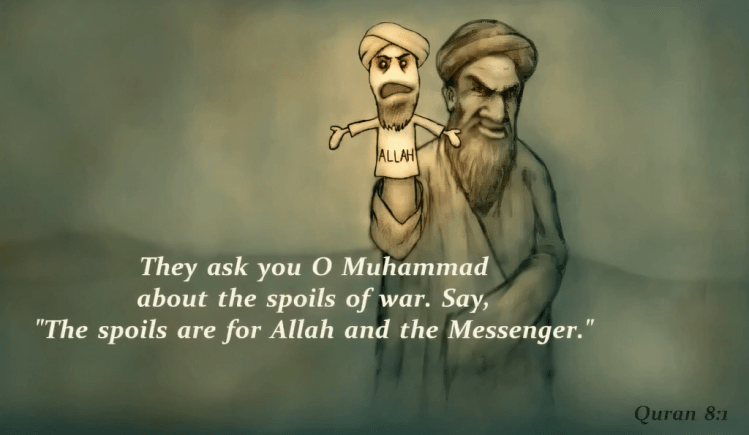
The Qur’an is a faithful mirror of the life and character of its author. It breathes the air of the desert; it enables us to hear the battle cries of the Prophet’s followers as they rushed to the onset; it reveals the working of Muhammad’s own mind, and shows the gradual declension of his character as he passed from the sincere visionary enthusiast into the conscious impostor and open sensualist. In this article, we will provide ten clear instances where Muhammad invented revelations for political and personal advantage.
*****
1
When Muhammad wanted his men to raid caravans in violation of Rajab – one of the sacred or ‘prohibited’ months in Islam – Allah revealed this verse in support:
They ask thee concerning fighting in the Prohibited Month. Say: “Fighting therein is a grave (offence); but graver is it in the sight of Allah to prevent access to the path of Allah, to deny Him, to prevent access to the Sacred Mosque, and drive out its members.” Tumult and oppression are worse than slaughter. [2:217]
*****
2
When Muhammad needed a pretext to renege on his covenant with the Jewish tribes of Medina, Allah revealed this verse in support:
If thou fearest treachery from any group, throw back (their covenant) to them, (so as to be) on equal terms: for Allah loveth not the treacherous. [8:58]
*****
3
When Muhammad wanted to break the Treaty of Hudaybiyya, obliging Muslims to return those who flee from the Quraysh, Allah revealed this verse in support:
O ye who believe! When there come to you believing women refugees, examine (and test) them: Allah knows best as to their Faith: if ye ascertain that they are Believers, then send them not back to the Unbelievers. They are not lawful (wives) for the Unbelievers, nor are the (Unbelievers) lawful (husbands) for them. [60:10]
*****
4
When Muhammad wanted to marry the wife of his adopted son Zaid, but feared a backlash from his followers, Allah revealed this verse in support:
Behold! Thou didst say to one who had received the grace of Allah and thy favour: “Retain thou (in wedlock) thy wife, and fear Allah.” But thou didst hide in thy heart that which Allah was about to make manifest: thou didst fear the people, but it is more fitting that thou shouldst fear Allah. Then when Zaid had dissolved (his marriage) with her, with the necessary (formality), We joined her in marriage to thee: in order that (in future) there may be no difficulty to the Believers in (the matter of) marriage with the wives of their adopted sons, when the latter have dissolved with the necessary (formality) (their marriage) with them. And Allah’s command must be fulfilled. [33:37]
*****
5
When Muhammad wanted more than four wives, Allah revealed this verse in support:
O Prophet! We have made lawful to thee thy wives to whom thou hast paid their dowers; and those whom thy right hand possesses out of the prisoners of war whom Allah has assigned to thee; and daughters of thy paternal uncles and aunts, and daughters of thy maternal uncles and aunts, who migrated (from Mecca) with thee; and any believing woman who dedicates her soul to the Prophet if the Prophet wishes to wed her; this only for thee, and not for the Believers (at large). [33:50]
*****
6
When Muhammad wanted to have sex with his female slave, Allah revealed this verse in support:
O Prophet! Why holdest thou to be forbidden that which Allah has made lawful to thee? Thou seekest to please thy consorts. But Allah is Oft-Forgiving, Most Merciful. [66:1]
*****
7
When Muhammad wanted to change the qiblah (direction of prayer) to win over the Jews, Allah revealed this verse in support:
We see the turning of thy face (for guidance to the heavens): now Shall We turn thee to a Qiblah that shall please thee. Turn then Thy face in the direction of the sacred Mosque: Wherever ye are, turn your faces in that direction. The people of the Book know well that that is the truth from their Lord. Nor is Allah unmindful of what they do. [2:144]
*****
8
When Muhammad didn’t want people to linger in his house before or after meals, Allah revealed this verse in support:
O ye who believe! Enter not the Prophet’s houses – until leave is given you – for a meal, (and then) not (so early as) to wait for its preparation: but when ye are invited, enter; and when ye have taken your meal, disperse, without seeking familiar talk. Such (behaviour) annoys the Prophet: he is ashamed to dismiss you, but Allah is not ashamed (to tell you) the truth. [33:53]
*****
9
When Muhammad heard that someone wanted to marry Ayesha after his death, Allah revealed this verse condemning it:
And when ye ask (his ladies) for anything ye want, ask them from before a screen: that makes for greater purity for your hearts and for theirs. Nor is it right for you that ye should annoy Allah’s Messenger, or that ye should marry his widows after him at any time. Truly such a thing is in Allah’s sight an enormity. [33:53]
*****
10
When Muhammad was asked about allowing women to give themselves to him, Allah revealed this verse in support:
Thou mayest defer (the turn of) any of them that thou pleasest, and thou mayest receive any thou pleasest: and there is no blame on thee if thou invite one whose (turn) thou hadst set aside. This were nigher to the cooling of their eyes, the prevention of their grief, and their satisfaction – that of all of them – with that which thou hast to give them: and Allah knows (all) that is in your hearts: and Allah is All-Knowing, Most Forbearing. [33:51]
*****
Allah prays to himself?
Thus far, we have provided ten examples of Qur’anic verses which were obviously composed by Muhammad to advance his own personal and political ambitions. However, there are also many verses which, by virtue of their phraseology, cannot be considered the words of Allah. In his seminal study of Muhammad’s prophetic career, titled Twenty-Three Years, the late Iranian philosopher Ali Dashti cites the entirety of Surat al-Fatihah as a case in point. The surah reads as follows:
In the name of Allah, Most Gracious, Most Merciful.
Praise be to Allah, the Cherisher and Sustainer of the worlds;
Most Gracious, Most Merciful;
Master of the Day of Judgement.
Thee do we worship, and Thine aid we seek.
Show us the straight way,
The way of those on whom Thou hast bestowed Thy Grace, those whose (portion) is not wrath, and who go not astray.
These verses are addressed to Allah; they consist of praise to Allah and supplication for his help. Assuming that Allah wouldn’t be so vain as to pray to himself, we must conclude that these are the words of Muhammad. This difficulty would not have arisen if the surah had begun with the word ‘say’, as many others do. Surat al-Ikhlas, for example, opens with “Say: ‘He is Allah, the One and Only.'” Another example would be Surat al-Kafirun, which opens with “Say: ‘O ye that reject Faith!'”.
This difficulty did not escape Abdullah ibn Mas’ud, one of Muhammad’s scribes, who is considered by Muslims to be the greatest mufassir (Qur’anic exegete) of his time. Indeed, due to the fact that Surat al-Fatihah is clearly addressed to Allah, and assuming that Allah does not praise or talk to himself, Mas’ud did not actually consider the surah to be part of the Qur’an. He also applied this logic to Surat al-Falaq and Surat al-Nas, both of which begin with the words “I seek refuge with the Lord”.
 Alliance of Former Muslims