

“Those who cannot remember the past are condemned to repeat it.”
George Santayana, The Life of Reason (1905)
On October 7th 2023, the Islamic supremacists of Hamas sent scores of their men from Gaza into Israel. They proceeded to slaughter and abuse any Jews they could lay their hands on, executing children in front of their parents, gang raping and sexually mutilating young women, and proudly broadcasting all of this to the world. These atrocities have commanded unwavering support from young Western leftists, who have deluded themselves into thinking that Hamas are freedom fighters seeking to liberate Palestine from Zionist occupation, rather than jihadist fanatics seeking to annihilate the Jews and establish shari’ah. For months on end, they have marched in solidarity with whom they believe to be the Palestinian “resistance”.
The defence of Islamic supremacists by the far-left is a textbook case of confirmation bias. To confirm their belief in Hamas as fellow anti-imperialists, Western leftists ignore or deny their religious extremism. They convince themselves that acts of religious violence are actually acts of defiance against Western imperialism. This is the same fatal mistake which has underpinned previous alliances between the far-left and the Islamic far-right. More than forty years ago in Iran, Islamists and the radical left joined forces, and the destructive consequences of that alliance provide us with crucial lessons for the present day. We will delve into those lessons here, adapting and expanding the words of the Ex-Muslim author Armin Navabi.
*****
The Black and the Red
In the decades prior to 1979, Iran enjoyed significant progress in economic development, women’s rights, education, health, and other areas. Many of these positive developments, which occurred under the rulership of Reza Shah and his son Mohammad Reza Shah, provoked the fury of the Islamic clerical establishment. In tandem with this, the Shah’s repression of dissent and restriction of political freedoms galvanised restless Iranian leftists. In 1979, these two camps would combine to overthrow the Shah in an Islamic Revolution, with deadly consequences for those same leftists and the Iranian people as a whole.
In the years leading up to the revolution, Iranian leftists, deeply influenced by communist theories and literature, were growing impatient. Lacking the means to mobilise a people’s revolution by themselves, they found allies in the Islamic clergy. Many mullahs, including the Ayatollah Khomeini, grew increasingly enraged with the Shah due to their progressive reforms concerning women’s rights, which contradicted Islamic law (shari’ah). Iranian leftists observed the mullahs’ fight against the Western-backed Shah, and summarily concluded that they were anti-imperialists. By uniting with the mullahs and using their vast network of mosques and popular influence, the far-left reasoned, they would be powerful enough to overthrow imperialism.
Now of course, the conservative religious values of Islamic clergymen directly clash with the progressive socialist values of the far-left. Alas, cognitive bias led Iranian leftists to ignore or deny the religious fundamentalism of Khomeini and company. Thus, in forging a pact with the mullahs – which Mohammad Reza Shah famously referred to as the unholy alliance between “the black and the red” – these leftists believed that they could work together to stage a successful revolution against capitalism and colonialism. This would prove to be wishful thinking, to say the least. Before long, the far-left would be nothing more than a prop for clerical fascism, to be subsequently discarded, outlawed, and finally destroyed.
The calamitous mistake of Iranian leftists to view Khomeini and other firebrand Islamists as anti-imperialists would only be compounded by the efforts of the sociologist Ali Shariati, who reinterpreted Islam with a strong emphasis on social justice by incorporating elements of revolutionary Marxism. Thus, leftists who previously felt compelled to ignore or deny the religious fundamentalism of the mullahs no longer had anything to fear. By merging these ideologies, Shariati was able to convince many Iranian leftists that to fight for an Islamic Republic was to fight against imperialism, and mobilise the Muslim masses (especially the youth) against the Shah dynasty. His ‘Red Shi’ism’ ideology was the single most influential doctrine that led to the revolution.
The revolution succeeded. The Shahs were deposed and the Ayatollah Khomeini emerged as the leader of Iran. It didn’t take long after the triumph of the revolution, however, for leftist ideals to be cast aside.
*****
The Hijab Protests
In the very first year of the new regime, on March 7th 1979, the Ayatollah Khomeini decreed mandatory veiling for women at work. On March 8th, International Women’s Day, Iranian women took to the streets in large-scale protests against the compulsory hijab. Many women on the left, who once adopted the veil as a sign of resistance during the revolution, did not anticipate it becoming mandatory. “We didn’t have a revolution to go backwards”, the crowds chanted.
The veil mandate was perceived by many as a sign that women, who had actively participated in the revolution, were now “back to dog status”, as one protest leader put it. The civil rights that women had gained during the Shah’s rule – including the right to divorce, the curtailing of polygamy, and raising the minimum marriage age (see the Family Protection Laws) – were suddenly at risk.
Homa Nategh, an active participant in the revolution, was present at the March 8th protests. Demonstrating her commitment to the black and red alliance, Nategh stated, “Women of Iran are used to hijab. Have no problem with hijab.” She believed that wearing the hijab was part of the struggle against imperialism. “If Hijab is the only means to get free of imperialism – if it’s the price – we’ll pay.” She went as far as to hyperbolically say, “Hijab is not our women’s problem, and to fight against imperialism, if necessary, we will even wear a blanket.”
In a self-reflective interview years later, Nategh recounted her pivotal role in those events. She described approaching female demonstrators and urging them to cease their protests, under the belief that unity with the mullahs was paramount. “We must have a united voice”, she stated. Nategh acknowledged her significant influence, admitting, “It was me who finished the women’s protests. I was the reason for it. Because left parties were listening to me.” She recalled the heartbreak and confusion of the protesting women, who feared a backslide of women’s rights. “Lots of sad [female protestors] came to me to question my act. [They told me:] ‘It’s not going to get right. This suppression is going to get worse.’”
Despite their pleas, for the sake of “unity” with the Islamic clergy, Nategh convinced the protestors to stop, leading to her self-professed betrayal of Iranian women. “I was an important part of it. They were moving their veils on top of their heads hoping that somebody would help them. Nobody came, none of the parties went to join them.” In a subsequent apology to Iranian women, Nategh expressed regret for her actions and the unforeseen consequences: “I did not realise that the person who tells me how to dress will later tell me how to think.”
*****
Islamist Apologia
Sadegh Khalkhali, a hardline cleric and head of the Islamic Revolutionary Court after the revolution, was infamous for his harsh and often brutal judgements, including ordering the execution of hundreds of people associated with the previous regime. In some cases, Khalkhali carried out the executions himself. He quickly became known as “The Hanging Judge” and was supported by the Tudeh Party, i.e. the Iranian communist party – even nominating him as the party-supported candidate in elections.
In the grip of delusion about the Islamist movement, the Tudeh Party rationalised the mass executions by Khalkhali as “anti-imperialist” – just as today’s Western leftists rationalise the mass murder of Jews by Hamas as “anti-Zionist”. Noureddin Kianouri, a prominent Tudeh member, defended Khalkhali’s actions as necessary to suppress counter-revolutionary elements and supporters of the former regime. In weekly Q&A sessions held in the early days of the revolution, Kianouri said:
Khalkhali has rendered valuable services in the field of suppressing counter-revolutionaries, criminals, and proponents of the former regime… With unparalleled courage, he sent several hundred of the most important figures of imperialism to the firing squad.
In 1981, Iran outlawed all political parties except the Islamic Republic Party. At this point, it should have been blindingly obvious to the Tudeh Party that the black and red alliance was over, that anti-imperialism was not on the agenda, and that Iranian leftists were in danger. Instead, they kept the faith. They maintained the fantastical belief that by intensifying the anti-American aspect of the revolution and courting the support of the Soviet Union, the Islamic Republic would become more anti-imperialist. They were in for a rude awakening.
*****
The Purge
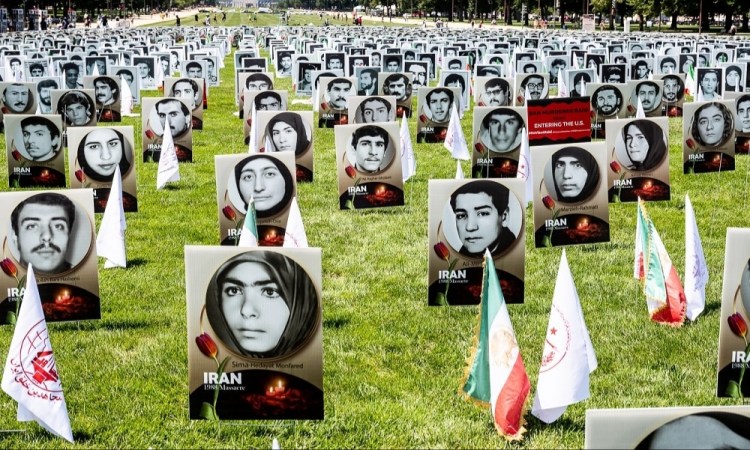
In 1988, the Islamic Republic began coordinating extrajudicial mass executions of political prisoners, including members of the Tudeh Party and supporters of other leftist political groups. The main target of the killings was the Mojahedin-e-Khalq (MEK), a militant leftist group. Khomeini issued an order for their execution, referring to them as “moharebs” (those who wage war against Allah) and “mortads” (apostates from Islam) to justify their elimination. The Ayatollah had never wanted the help of the hell-bound atheistic Marxists, and since they had long outlived their use, it was time to get rid of them. The Islamic crocodile that Iranian leftists had so innocently and generously fed would now swallow them whole. In part, the letter read:
In the Name of God,
The Compassionate, the Merciful,
As the treacherous Monafeqin [MEK] do not believe in Islam and what they say is out of deception and hypocrisy, and as their leaders have confessed that they have become renegades, and as they are waging war on God, and as they are engaging in classical warfare in the western, the northern and the southern fronts, and as they are collaborating with the Baathist Party of Iraq and spying for Saddam against our Muslim nation, and as they are tied to the World Arrogance, and in light of their cowardly blows to the Islamic Republic since its inception, it is decreed that those who are in prison throughout the country and remain steadfast in their support for the Monafeqin [MEK] are waging war on God and are condemned to execution.
The wave of Iranian political killings in 1988 was one of the largest mass executions of the late 20th century, and one that has largely been forgotten outside of Iran or the Iranian diaspora. The exact death toll remains uncertain. Most sources agree that thousands were executed, with estimates ranging from 4,000 to 30,000 people – the majority of whom were loaded onto trucks in large groups, brought to designated sites, and hanged. The Tudeh Party was eradicated.
Today, Iran ranks among the least free countries in the world. LGBT people have virtually no rights. Same-sex behaviour between gay men is a crime that is routinely punished with death. Indeed, thousands of LGBT people have been executed by the Islamic regime since 1979. Women who refuse to wear the hijab risk brutal attacks, imprisonment, or even death, as the much-publicised case of Mahsa Amini showed. Religious and ethnic minorities, such as Baha’is and Baluchis, are treated as second-class citizens or worse. How might things have turned out if the progress prior to the Islamic Revolution had been allowed to continue?
*****
Historic Recurrence
The trends, behaviours, and beliefs that led to the disastrous Islamic Revolution are now repeating themselves in the West. The most prominent example is the wave of anti-Israel and pro-Hamas protests following the October 7th attacks, despite the fact that Hamas rule been a nightmare for women, LGBT people, and their own civilians. Other warning signs include the case of Hamtramck, Michigan, where a Muslim-majority council backed by progressives voted to ban Pride flags, and the spate of naive young TikTokers siding with Osama bin Laden’s notorious ‘Letter to America’.
In the pursuit of their anti-establishment goals, many Western leftists form alliances with Islamist movements. They observe Hamas and the Islamic Republic fighting Israel, and summarily conclude that they are anti-imperialists. The fact that Islamists oppose women’s rights, secular governance, and basic freedoms; the fact that they criminalise homosexuality and bisexuality in every society they control, is ignored or denied. Thus, cognitive bias risks empowering forces that, given requisite power, would establish regimes that are far more oppressive than those which they replace. In their misguided quest for a radical overhaul of society, the far-left are willing to discard tangible human progress for the sake of an idealised, hypothetical future.
In Iran, decades of progress in economic development, women’s rights, and more were thrown away in the Islamic Revolution. A fossilised and inept theocracy has turned one of the great ancient civilisations, auspiciously situated at the centre of global trade and presiding over some of the world’s largest oil and gas reserves, into a dumpster fire of a country. Iran’s infrastructure is comparable with that of a war-torn state; at least half of the population lives below the poverty line. The West, which is so much further along, has even more to lose.
The West has been sculpted by liberal ideals such as democracy, individual freedom, LGBT rights, women’s rights, civil liberties, secularism, and the rule of law. Two hundred years ago, three-quarters of the world lived in extreme poverty. Today, this figure has decreased to less than 10%. Over this same span, life expectancy has soared in parallel with the expansion of liberal democracies.
There is a misconception that our current state of well-being is a permanent, fixed baseline that we can take for granted. In reality, progress can be fragile and temporary. The rights and freedoms that we enjoy today are not guaranteed tomorrow. They are recent gifts of history, not immutable laws of nature. The potential to regress is real – just look at how Turkey has regressed under Erdogan. While the champions of illiberal ideas fight tooth and nail for their beliefs, the guardians of liberal values seem to be fast asleep.
Despite facing myriad external adversaries, the greatest threat to liberal values comes from within. By allying themselves with Islamists, leftists and the disciples of ‘multiculturalism’ inadvertently enable the destruction of civilisation. This betrays a profound failure to learn from history. In the spirit of learning, let us finish with a prescient quote from the late Christopher Hitchens:
The barbarians never take a city until someone holds the gates open to them. And it’s your own multicultural authorities who will do it for you.
*****
Recommended Reading
- Ervand Abrahamian – Tortured Confessions: Prisons and Public Recantations in Modern Iran
A deeply researched and chilling account of how the Islamic Republic of Iran used public confessions, show trials, and prison torture to suppress dissent – particularly targeting the secular and leftist opposition. Abrahamian, a leading historian of modern Iran, devotes significant attention to the Tudeh Party’s alliance with the Islamic regime, showing how it stemmed from a sincere (if ultimately naive) anti-imperialist commitment rather than mere opportunism. He explores how the party rationalised its support, even in the face of growing repression, and how this paved the way for its eventual decimation.
- Maziar Behrooz – Rebels with a Cause: The Failure of the Left in Iran
A critical and balanced study of the Iranian left from the 1940s to the early 1990s, with a sharp focus on the ideological blind spots, strategic errors, and internal fractures that led to its marginalisation and eventual collapse. Behrooz provides a sober analysis of how groups like the Tudeh Party misread the nature of the Islamic Revolution, interpreting Khomeini’s rhetoric through an anti-imperialist lens and assuming a shared revolutionary agenda. His treatment of the Tudeh is especially valuable in showing how deep ideological commitments can cloud political judgement – turning solidarity into self-destruction.
 Alliance of Former Muslims
Brilliant! Hope some Leftists are reading your informaition.
LikeLiked by 1 person
This is pretty well narrated in “Persepolis” by Marjane Satrapi…
LikeLiked by 1 person