

“The first duty of a man is the seeking after and the investigation of truth.”
Cicero, On Duties (44 BC)
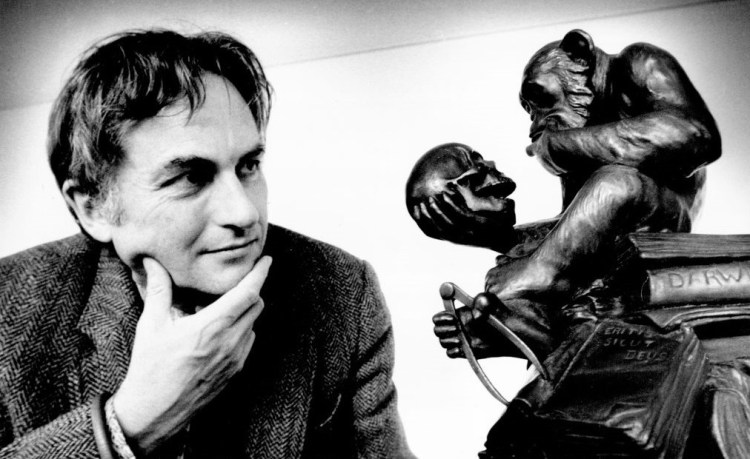
Richard Dawkins is one of the most influential scientists and public intellectuals of the past fifty years. His exhaustive understanding of the natural world and determination to convey its wonders combine to make him one of the all-time great communicators. From The Selfish Gene (1976) to Flights of Fancy (2019), Dawkins’ elegant elucidations of evolution have enabled so many of us to recognise our common ancestry. In a series of vignettes filmed in 2009 at the University of Nebraska State Museum, Dawkins presents a vertical slice of the evidence for evolution, from intermediate fossils to comparative genomics:
Arguably, Dawkins’ defining work remains The Selfish Gene. In this masterwork, described by the Royal Society in 2017 as the most influential science book of all time, Dawkins draws upon ideas developed by W.D. Hamilton and others to argue that natural selection operates at the level of the gene, rather than the individual or group. Genes whose phenotypic effects successfully promote their own propagation will be favourably selected relative to their competitor genes within the population. Organisms can thus be thought of as survival machines for genetic information. Here is how Dawkins explains it in a discussion with Sam Harris:
The gene-centred view of evolution helps us cut through group selection fallacies, which remain popular today. For example, there are many who believe that homosexuality can be understood as a form of natural population control, i.e. that the genes for same-sex attraction – and thus, the absence of procreation – are selected to prevent overpopulation within a species. In fielding a series of questions on evolution for Darwin Day, Dawkins explains the basic error of this reasoning. He also tackles questions to do with speciation and outlines how instinctive behaviours come about via the selection of genes for faster learning rates:
But of course, Dawkins’ writings are beloved not merely for their explanatory power, but for their profundity. His sobering reflections on the extraordinary improbability of life and the vast and awesome universe in which we dwell has helped us appreciate our true place in the cosmos. This wonderful quality of Dawkins’ works is on full display in Unweaving the Rainbow (1998), in which he discusses the relationship between science and the arts. This book acts as a rebuttal to the Romantic poet John Keats, who famously accused Newton of destroying the magic of the rainbow by explaining it. Here is a sample of this majestic prose:
A sincere commitment to the truth flows through Dawkins’ books. This commitment is why Dawkins is so concerned that evolution is understood by the general public. It is also why he dedicates so much time to fighting the ignorance of organised religion. “I am against religion”, as Dawkins puts it, “because it teaches us to be satisfied with not understanding the world.” From The Blind Watchmaker (1986) to Outgrowing God (2019), Dawkins has been leading a fearless crusade against creationism. In an address to Randolph College in 2006, Dawkins lambasts Liberty University for mislabelling dinosaur fossils as being 6,000 years old:
In repudiating the god of creationism, Dawkins has also done tremendous work to normalise atheism. The importance of this should not be underestimated, for although the West has come a very long way from burning heretics at the stake, there remains a stigma attached to not believing in God. This is especially true in the United States, where only 20 percent of people hold favourable views of atheists, and where 40 percent reject evolution. Dawkins’ staunch defence of atheism has empowered so many of us who have left religion to come out. In a public debate, Dawkins defends atheism against its confused critics:
To be an atheist, one must possess a certain degree of courage. It takes intellectual courage to challenge established beliefs and to overcome our personal incredulity at complex things arising from evolution, rather than special creation. It takes moral courage to accept that we do not survive death, that there is nobody watching over us, and that the responsibility is on us to decide what is moral, not some holy book. Indeed, real morality is not about trying to get into heaven or avoid hell, but an earnest consideration for the welfare of others. In the 2019 Darwin Day Lecture, hosted by Humanists UK, Dawkins makes this point eloquently:
In Muslim countries, where atheists are seen as despicable creatures who must be killed, it is difficult to overstate the impact of Dawkins’ writings. For those of us who have renounced Islam – and thus, are forced to keep our apostasy a secret – Dawkins’ books have been enormously empowering. In a society where there is so much compulsion to follow religion, reading The God Delusion has assured us that we are not alone. Small wonder, then, that the Arabic translation is one of the most pirated books of all time in the Islamic world. In her discussion with Dawkins, the Saudi Ex-Muslim Rana Ahmad expresses this sentiment:
As an evolutionary biologist, it is only natural that Dawkins’ attacks on religion primarily focus on creationism. However, he has certainly not shied away from taking on the evil that it promotes. Indeed, Dawkins has directly confronted religious bigots on gay marriage and stressed the connection between religious faith and terrorism. He has also described religious indoctrination as a form of mental child abuse, and challenged the absurd notion that religion is required for morality, pointing out the wickedness of scriptural ethics – and thus how, if anything, to be moral requires us to ignore the teachings of religion:
In Islam, there is no shortage of cruel and unusual precepts. Chief among these is the death penalty for apostasy. Among the various sects of Islam, it is unanimously agreed that those who leave the faith must be put to death; the only differences concern whether the apostate should be given three days to relent before being executed. It is to Dawkins’ great credit that he has spoken out against this barbaric ruling. In a panel discussion on the teaching of religion in schools, Dawkins relentlessly challenges Mohamad Mukadam, chairman of the Association of Muslim Schools, to state what the penalty is for apostasy:
Dawkins’ criticism of irrational beliefs is primarily targeted at religion, but it is not confined to it: rather, he has also made it his mission to expose New Age quackery and the wilful obscurantism of mystical gurus. This is vital, for among those who give up religion, there are many who retain the dogmatic mindset that underpins it; thus, they gravitate to other popular falsehoods. Embracing the scientific method is a powerful guard against this. In a public debate with Deepak Chopra, Dawkins tears into the notorious charlatan for using terms such as ‘quantum’ and ‘consciousness’ to give scientific plausibility to unfalsifiable nonsense:
Dawkins’ steadfast commitment to the truth renders him immune from the bizarre postmodernist ideologies that preponderate today. This includes gender ideology, which denies the biological basis of sex and claims that one can become a man or a woman simply by declaring oneself to be so. It is laughable that many atheists who ridicule the notion of transubstantiation – that is, turning wine into the blood of Jesus simply by declaring it to be so – simultaneously propagate this magical nonsense. On an episode of The Poetry of Reality, Dawkins makes it clear that he rejects gender ideology and affirms the binary nature of biological sex:
Naturally, for standing up to religious ignorance and bigotry, Dawkins is despised by the faithful. These good Christians and Muslims have duly flooded Dawkins’ inbox with love letters, many of which call for violence against him. However, rather than taking offence to these people or lashing out at them, Dawkins takes it in his stride. In fact, he derives great pleasure from reading these emails aloud, and has recorded several videos of this nature for YouTube. In doing so, he practises what he preaches about perennial offence-takers – namely, that “offence is what people take when they can’t take an argument.” Here is but one of them:
For his criticism of religion, Dawkins has often been accused of being “strident”. This charge is typically levelled by insecure religious people, who put their self-worth in their faith; thus, even the most moderate criticism is seen as objectionable. Despite their protestations, it is not the tone of the criticism they object to, but the criticism itself. Dawkins and other ‘New Atheists’ have also been accused of stridency by liberals who dare not disturb the taboo on criticising religion. In the celebrated ‘Four Horsemen’ roundtable discussion, Daniel Dennett explains how moderating his language in Breaking the Spell did nothing to pacify religious readers:
Dawkins is further attacked by ‘liberal’ misanthropes, who abandon their principles when it comes to Islam. These are people who view Muslims as having so little agency that they think of Islam as a race – and thus, that criticism of Islam is racist. These are people who presume Muslims to be incapable of moral progress; thus, while criticising misogyny and homophobia at home, they give Muslims a free pass. This is the bigotry of low expectations, and it is to be abhorred. In a discussion with Mary Ellen Hannibal, Dawkins calls out this tendency and emphasises that Muslims are victims of oppression from Islam, not the West:
In this article, we will take a stroll through some of Dawkins’ best long-form works on video. In doing so, we will pay tribute to this great man. We hope that it will be enjoyed by truth-seekers of all stripes. And if the professor himself happens to be reading this, thank you Richard from the bottom of our hearts.
*****
The Illusion of Design
In 1825, the great physicist and chemist Michael Faraday, known as The Father of Electromagnetism, established the Royal Institution Christmas Lectures for Children. In 1991, Richard Dawkins had the privilege of delivering these lectures, collectively titled ‘Growing Up in the Universe’. In this five-part series, which can be enjoyed by young and old minds alike, Dawkins offers a sweeping overview of life, the universe and our place in it. Using illuminating demonstrations, wildlife and virtual reality, Dawkins provides a masterclass in how science should be taught. For the purposes of this article, we will focus on just two of these lectures.
In lecture 2, titled ‘Designed and Designoid Objects’, Dawkins draws a distinction between simple objects such as stones and crystals, designed objects such as microscopes and pocket-watches, and ‘designoid’ objects – that is, objects which have the appearance of design, but are actually of natural origin, such as snakes and ourselves. With one vivid example after another, Dawkins demonstrates how easy it is for us to mistake designoid objects for designed objects. Dawkins goes on to explain how the appearance of design in nature can be explained by Darwinian evolution, using computer programs to simulate the processes of artificial selection and natural selection – and in doing so, dispenses with the natural theology of William Paley and his modern successors in the ‘Intelligent Design’ movement.
*****
The Evolution of Complexity
Sticking with the Royal Institution Christmas Lectures, we would be remiss not to highlight lecture 3, titled ‘Climbing Mount Improbable’. Here, Dawkins focuses on the obstinate creationist objection that complex things cannot come into existence by random chance, and thus require a designer. Dawkins shows that indeed, complex things do not arise from random chance, but from the decidedly non-random process of natural selection. The accumulation of small changes over ecological time (cumulative selection) is what allows for the formation of such intricate structures as eyes and wings, not sudden leaps from nothing to something (single-step selection). Once again, Dawkins makes his argument using striking visual demonstrations and intuitive computer simulations, imbued with a reverence for the natural world.
*****
The Evils of Religion
In 2006, Richard Dawkins set the world on fire with The God Delusion, a magisterial takedown of the Creator God of organised religion and a valuable contribution to the discourse on religion and morality. This same year, Dawkins presented Root of All Evil?, a two-part series examining the perils of religious faith and the fundamental incompatibility of religion with science. In this programme, Dawkins travels the world to engage with representatives of Christian, Muslim, Jewish and other religious groups, challenging them on evolution and the dubious ethics of scripture. In these robust exchanges, the mask of civility slips from these “community leaders”, revealing the sanctimonious dogmatists that religions, with their claims to absolute truth and exclusionary claims to salvation, invariably create.
*****
The Perils of Unreason
In 2007, Richard Dawkins presented ‘The Enemies of Reason’, a two-part series examining the resurgence of pseudoscience and alternative medicine in the 21st century. Reminding us that reason and science are the backbone of human progress, Dawkins expresses his consternation over this epidemic of irrationality and its exploitation of the desperate. With scientific rigour, Dawkins runs the gamut of astrology, clairvoyance, spiritualism, water divination, faith healing, homoeopathy, chakra balancing, consciousness shifting, kinesiology and Ayurveda, exposing the fallacies of each one and confronting those who profit from them. Dawkins also offers evolutionary explanations for the prevalence of superstition and warns against the disastrous consequences of disregarding evidence in favour of private prejudice.
*****
The Legacy of Darwin
In 2009, Richard Dawkins presented ‘The Genius of Charles Darwin’, a three-part series celebrating the 150th anniversary of the publication of On the Origin of Species. In part one, Dawkins charts Darwin’s intellectual journey as a young naturalist and uses uncensored footage of Kenyan wildlife to explain natural selection – the survival of the fittest – as the engine of evolution. In part two, Dawkins elucidates how the gene-centred view of evolution can explain altruistic behaviour among humans, but cautions against using natural selection as the basis for building a society, thus tackling the issue of social Darwinism. In part three, Dawkins confronts various creationist cranks, takes on the relativist nonsense that undermines the teaching of evolution, and explores the implications of Darwin’s ideas for life’s meaning.
*****
The Scourge of Faith Schools
In 2010, Richard Dawkins presented ‘Faith Schools Menace’, a one-off programme investigating schools where children are taught that one particular religion is the truth. Throughout the West, insecure religious parents send their children to these institutions to indoctrinate them in their faith. In a gesture towards multiculturalism, these schools are funded by the taxpayer. This is deeply misguided, for segregating children along religious lines only leads to a more divided society. This is especially true when the schools are run by fanatics, e.g. Saudi-funded madrassahs where children are taught to hate Jews and gays. In this programme, Dawkins confronts the headmasters of various religious schools in the UK, where evolution is denied and where Bronze Age scripture is presented as the absolute truth:
 Alliance of Former Muslims